Wildlife & Birds
Peacock and Peahen: Male vs Female, and the Peafowl of Nepal
Himal Shahi Thakuri · Oct 26, 2026 · 20 min read
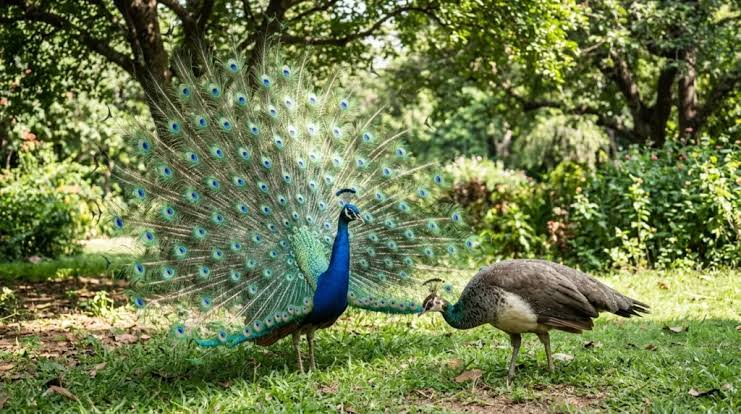
Ask almost anyone to picture a peacock and they will describe the same thing: a blue bird with a huge fan of green and gold feathers, each one marked with a shining eye. What fewer people picture is the bird walking quietly a few metres away, brown, mottled and easy to miss. That bird is the peahen, and she is the same species. She does most of the real work of raising the next generation.
The peacock and the peahen look so different that they could be mistaken for two kinds of bird. Yet they are male and female of the same animal, and the contrast between them is one of the most famous examples of sexual dimorphism in nature. Charles Darwin was bothered by the peacock’s tail for years, and scientists are still arguing about why it exists.
This article covers the practical questions first: what the words mean, which species live in Nepal, and how to tell male from female. Then it moves to the deeper ones. What is the train, really? How does courtship work? Does the peahen truly choose the best-looking male? How does she raise her chicks? It ends with what is known about peafowl in Nepal, how to watch them responsibly and how to avoid conflict with farmers. Sources are listed at the end.
Peafowl, Peacock, Peahen: Getting the Words Right
In everyday speech, people call the whole species “peacocks”. Strictly speaking, that is wrong. Peafowl is the name of the species, or more precisely the group of species. The male is the peacock, the female is the peahen, and the young are peachicks. A group of peafowl can include all of these.
The confusion is understandable, because the male is so striking that his name has swallowed the species. Even zoo guides and encyclopedias note that both sexes are often called a peacock in casual conversation. If you want to be accurate, use peafowl for the species or for a mixed group, peacock for a male and peahen for a female.
In Nepali and many other South Asian languages the bird is commonly called mayur (मयूर), a word with Sanskrit roots that is also used across the region. Local names and spellings vary from place to place, so if you know a different name used in your area, it is worth adding to your own version of this post.
Three Species, One in Nepal
There are three species of peafowl in the world. The Indian peafowl, also called the blue peafowl or common peafowl (Pavo cristatus), is native to the Indian subcontinent. The green peafowl (Pavo muticus) lives in Southeast Asia, including Java, and is more threatened. The Congo peafowl (Afropavo congensis) lives in the rainforests of central Africa and looks quite different, with a male that uses his actual tail feathers for display.
Only the Indian peafowl is native to Nepal. According to BirdLife International, it is present in Nepal in places including Chitwan National Park, Bardia National Park, Parsa Wildlife Reserve, Sukla Phanta Wildlife Reserve, Koshi Tappu Wildlife Reserve and the Koshi Barrage area, Barandabhar forests and wetlands, the Dang-Deukhuri foothill forests and West Rapti wetlands, Ghodaghodi Lake, Dharan forests and farmlands around Lumbini. It is listed as Least Concern globally, and its population is suspected to be stable in the absence of evidence of declines or major threats.
That global status does not mean that every local population is safe. It means that the species as a whole is widespread and adaptable. In Nepal, as elsewhere, local numbers depend on whether forest patches, grassland, water and safe roosting trees are still there.
How to Tell a Peacock From a Peahen
In the Indian peafowl, the difference between the sexes is dramatic, and it is easy to learn once you know what to look at.
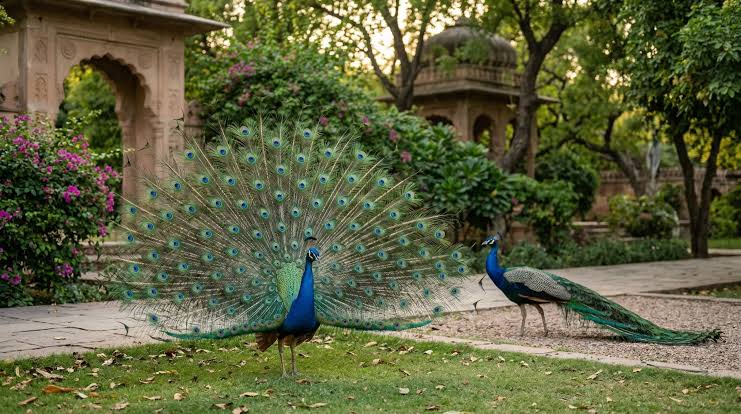
The head and neck. The peacock has a metallic blue crown and a rich blue neck and breast. The sides of the head show iridescent greenish-blue feathers and whitish bare skin around the face. The peahen has a rufous-brown head and a more mottled, duller neck, with some metallic green on the lower part. In the non-breeding season, when the male has lost his train, you can still separate the sexes by the neck, which is blue on the male and green on the female.
The crest. Both sexes have a crest on top of the head. On the male it is a fan of thin, wire-like feathers with bare black shafts and bluish-green tips shaped like tiny spoons. The peahen’s crest is shorter and chestnut, edged with green.
The body. The male’s back is covered in scaled, iridescent green and bronze feathers, and his belly is dark. The female is mostly chestnut or mottled brown above, with a darker belly. This dull colouring is camouflage. A bird sitting on a ground nest for weeks needs to look like dead leaves and soil, not a jewel.
The train. This is the clearest sign. Adult peacocks have the long train of eyed feathers trailing behind them. Peahens have no train at all, only a short brown tail.
Size. Indian peafowl are among the largest and heaviest members of the pheasant family. Adult males are commonly given as about 4 to 6 kilograms, and with the train their total length can reach roughly 1.8 to 2.3 metres. Peahens are much smaller, commonly given at somewhere around 3 to 4 kilograms, and about a metre long. Different sources give slightly different figures, because individual birds vary and because the train adds so much to the male’s length.
Behaviour. Males display, strut and call loudly. Females are quieter, more secretive and more likely to be found in cover with chicks. During the breeding season you may also see one male accompanied by several females.
The Train That Is Not a Tail
Here is one of the most surprising facts about the peacock: the famous train is not his tail. It is made up of hugely elongated upper tail coverts, feathers that normally cover the base of the tail in other birds. A peacock has more than 200 of these long feathers, and nearly all of them end in an eyespot. The true tail is short, brown and made up of only about 20 feathers, and its job is to prop the train up when the bird displays.
The train can be about 1.6 metres long, or roughly five feet. Each eyespot, scientifically called an ocellus, shines with blue, green and bronze. These colours come from tiny structures in the feather that reflect light, not from pigment, which is why they seem to shift as the bird moves.
How many eyespots does a peacock have? A study of feral peafowl found that the maximum number in the train is consistent among adult males, at about 165 to 170, and that most of the variation people see comes from broken or missing feathers. In other words, a train with fewer eyespots is usually a damaged train, not a naturally smaller one.
The train does not stay forever. Males moult it every year after the breeding season, typically starting in late summer. Reports from the wild say that displays end seven to ten days before the male sheds his train. For a few months the peacock looks like a much plainer, shorter bird, and the long feathers grow back before the next season.
Young Birds, Late Bloomers and Surprising Peahens
A young peacock does not look like an adult. An immature male resembles an adult female, though with chestnut flight feathers. The long train feathers and the spurs on his legs develop only after his second year of life, and males are usually considered fully mature at around two to three years old. Young males start practising displays before they have a train to show.
This means that in a flock of brown birds, some of the “females” may actually be youngsters that will become peacocks. Experienced birdwatchers look at head and neck colour, size and behaviour, and are careful with individual identifications.
There is another oddity. Mature peahens have been recorded suddenly growing male-like plumage and giving male calls. This is rare, and it reflects the way hormones control feather growth in birds. Peahens also sometimes raise their feathers in display, but not to attract males. Researchers say that a female may display her plumage to ward off female competition or to signal danger to her young.
Colour Variants: White, Black-Shoulder and Hybrids
Indian peafowl come in several colour mutations. The best known is the white peafowl, which many people mistake for albino, though these birds are not true albinos and keep their normal eye colour. Another common form is the black-shoulder or melanistic variant. The gene responsible produces melanism in the male and a creamy white and brown dilution of colour in the female.
Indian peafowl can also hybridise with green peafowl, producing offspring sometimes called spaldings. These mixed birds are mostly seen in captivity. For wild populations in Nepal, the main point is that the birds you see in the Terai are normally the standard blue form. White or oddly coloured birds near villages are often escaped or released domestic birds.
The Courtship Display
When a peacock wants to attract a mate, he raises his train and unfolds it into a great semicircle of feathers, which can be six to seven feet wide. The true tail props the fan up from behind. If the peahen seems interested, he quivers and rattles the train so that the feathers shimmer and rustle, creating a blur of colour and sound.
Observers have noted that males often turn to present the display at an angle to the sun, which makes the iridescence blaze. When a female approaches, he turns to face her and shivers his train. If she responds, mating follows.
During the breeding season, males set up display sites and defend small territories. Several males may gather in a shared area known as a lek, and females visit to watch and choose. A single successful male may mate with several females in a season, while others mate rarely or not at all. After mating, the peacock plays no part in nesting or raising chicks.
Peafowl breeding is closely tied to the monsoon, which in the subcontinent means a season that runs roughly from spring or early summer into September, depending on region and rainfall. Calls also change with the season. Indian peafowl have a repertoire of around a dozen distinct calls, depending on how researchers count them, and males are the loudest, calling most in the morning and evening and almost all day during the breeding season.
Does the Peahen Really Choose the Best Train?
For more than a century, the standard explanation for the peacock’s train has been sexual selection, an idea Darwin developed in the nineteenth century. The train is costly. It is heavy, conspicuous and slows the bird down when he must escape a predator. It exists, the theory says, because peahens prefer males with the most impressive trains, so the trait keeps getting exaggerated over generations.
The best-known early support came from researcher Marion Petrie and her colleagues in the UK, whose work in the 1990s found that females chose males with more eyespots and bigger trains. In one experiment, researchers snipped the eyespots from some males’ trains, and the females snubbed them. Chicks of more ornamented males were also reported to survive better.
Then came a challenge. Mariko Takahashi and colleagues followed a free-ranging population at Izu Cactus Park in Japan for seven breeding seasons. Despite observing 268 matings, they could not pinpoint any single male trait that females consistently preferred, including train length and eyespot number. They concluded that the train was not the universal target of female choice. The study caused fierce debate, and defenders of the older theory argued that female choice may be flexible or influenced by copying other females.
A later study by Roslyn Dakin and Robert Montgomerie tried to settle the question. They found that peahens do prefer males with more eyespots, but only rarely. Removing 20 or more eyespots reduced a male’s success, but that is far outside the normal range seen during real courtship. Typical natural variation in eyespot number could not explain why some males mated more than others. Their conclusion was that females may reject a few males with substantially damaged trains while using some other cue to choose among males with typical trains.
Eye-tracking research has added another twist. In one experiment, peahens wore a tiny helmet to record where they looked during a male’s display, and their gaze appeared to focus mostly on the lower part of the train and the male’s lower body, not the eyespots at the top. Scientists suggest that the peahen may judge quality up close using cues we do not yet understand, such as feather structure, sound or movement.
So the honest answer is that the question is still open. The train is clearly shaped by sexual selection, but how females actually use it is more complicated than the simple textbook story.
The Peahen as Mother
If the peacock’s role ends with mating, the peahen’s job is just beginning. She chooses a nest site on the ground, usually in concealed vegetation, and lays a clutch of eggs. Sources give slightly different clutch sizes, but three to six eggs is typical, and some reports go higher. The eggs are pale brown or cream.
She incubates them alone for about 28 to 30 days, sitting almost constantly. This is where her camouflage matters most. A drab brown bird on a nest in dry leaf litter is hard for a predator to spot, while a brilliant blue peacock would be an easy target.
Peachicks hatch well developed and can follow their mother within hours. They are yellowish-brown with barred wings. In the first days, the peahen leads them into dense vegetation for shelter and points at food items with her bill to teach them what to eat. Within 12 to 15 days, the chicks can flutter up, and within a few weeks they can fly into low branches to roost with her at night. Chicks stay with their mother for months, and in some reports for more than a year. Researchers also describe cases where chicks from different broods mix, forming what are called gang broods, and note that brood defence by the mother increases as the season goes on.
Males start to join the all-male roosting groups at the end of their second year, and the young males leave the mother’s group. Females and young chicks roost separately from adult males.
Daily Life: Roosts, Flocks and Food
Peafowl are creatures of habit. They tend to live in the same area for their whole lives, and they follow a regular daily routine. In the wild they usually descend from their roost trees within the first couple of hours after dawn, forage on the ground through the cooler parts of the day, rest in shade in the heat, and fly up to roost about half an hour after sunset. Their feet have four toes, three pointing forward and one back, which helps them grip branches.
Despite their size, peafowl are strong fliers over short distances. They typically use flight to escape danger or to reach their roosts, not for long journeys. They are among the heaviest flying birds in the world.
Their social groups change with the season. Outside the breeding season they often live in small mixed or single-sex groups. During breeding, a male may be seen with several females, and some males gather in bachelor groups. They are generally recorded in groups of less than ten birds before the breeding season.
The diet is wide. Peafowl eat seeds, grains, shoots, flowers, fruit, insects and other small invertebrates, and they are also known to take small reptiles. This broad diet is one reason they adapt well to farmland and village edges, and one reason they come into conflict with farmers.
Peafowl in Nepal: What We Know
Nepal is not as well studied for peafowl as for tigers or rhinos, but some field research exists. One useful example is a study of the Ghailaghari Buffer Zone Community Forest in Chitwan, carried out between April 2012 and February 2013. Researchers counted 43 peafowl and estimated a density of about 28 birds per square kilometre. The birds preferred the Bhellar-Sissoo forest type, a mix of trees including Trewia and Dalbergia, over simal (silk cotton) forest and grassland. They used it more in summer than in winter, and the researchers concluded that this forest type offered the best combination of food, space and water.
The same study asked local residents about crop loss. Rice was the main crop damaged, making up about 61 percent of the loss attributed to peafowl in the survey, and respondents believed that a lack of food inside the forest was the main reason birds came to the fields. That is a useful reminder that crop raiding is often a symptom of habitat pressure.
The wider picture of human-wildlife conflict around Chitwan National Park is dominated by larger animals. A study of the buffer zone found that crop raiding was the most common problem, followed by livestock depredation, with 4,416 documented cases over the study period. Peafowl are a small part of that story, but for individual farmers a flock in a ripening rice field can still mean real losses.
Nepal’s National Red List of birds identifies habitat loss, degradation and fragmentation as the most important threats to the country’s birds in general. For a ground-nesting, tree-roosting bird like the peafowl, that means losing riverine forest, thickets, grassy patches and large trees. Pesticides, dogs and disturbance near nesting sites are additional risks, though I did not find Nepal-specific studies on those for peafowl.
One point worth stating plainly: I did not find a recent national population estimate for peafowl in Nepal. The numbers above are local and a decade old, and the global assessment is based on the absence of evidence for decline rather than a nationwide count. This is a gap that citizen scientists can help fill.
The Peacock and Nepal’s National Bird
Many people assume that the peacock is a national symbol everywhere in South Asia. It is the national bird of India, adopted in 1963, and it holds a place in religion and culture there. In Nepal, the national bird is the danphe, the Himalayan monal (Lophophorus impejanus). This detail comes from general knowledge rather than my searches, so please double-check it before publishing.
The comparison is interesting. The danphe, like the peafowl, belongs to the pheasant family. And like the peafowl, the male is a blaze of iridescent colour while the female is brown and well camouflaged. Both birds show how sharply male and female can differ in species where females choose mates and males compete for attention. But the monal lives high in the Himalaya, usually among rhododendron and alpine meadows, while the peafowl lives in the warm lowlands and foothills.
Living With Peafowl
For people who live near peafowl, a few practical points help both sides. If birds raid your crops, scare devices, early harvesting and guarding at dawn and dusk are more effective and safer for the birds than poison or traps. Poisoned grain is dangerous to many other species, including children and domestic animals, and in many places harming wild birds is illegal. Check the current law in Nepal and your local rules before taking any action against wildlife.
If you find a peahen on a nest, keep away. Disturbance can cause her to abandon the eggs, and the best help is to leave the site alone. If you find chicks without a mother, watch from a distance first, because the mother is often nearby.
Do not feed peafowl bread, biscuits or leftovers. These foods are poor nutrition and can teach the birds to depend on people, which increases conflict. Keep domestic dogs away from nesting areas.
Be careful about feathers. Moulted train feathers are shed naturally each year and can be collected in some places, but plucking feathers from live birds, or buying feathers of unknown origin, can support cruelty and illegal trade. Rules on feather collection and trade vary by country, and I did not retrieve Nepal’s specific provisions, so ask your local forest or park office.
Watching Peafowl Responsibly
If you want to see peacocks and peahens in Nepal, the Terai parks and their buffer zones are the best bet. BirdLife lists Chitwan, Bardia, Parsa, Sukla Phanta and Koshi Tappu among the sites where the species occurs, as well as wetlands and farmland in places like Lumbini and Ghodaghodi. Early morning and late afternoon are the best times, when birds are feeding in the open, and the breeding season, around the monsoon, is the best time to see displays.
Bring binoculars and keep your distance. A peacock in full display is unforgettable, but a bird that is repeatedly approached may stop displaying or leave the area. Move slowly, avoid sudden noise and let the birds decide how close to come. Use a local guide where possible, because their knowledge of where birds roost and display is valuable and your fee supports local livelihoods.
If you take photos, consider uploading your sightings to a citizen science platform such as eBird or iNaturalist, with the date, place and whether you saw a male, a female or a mixed group. Records like these help build the picture that Nepal currently lacks. Avoid posting exact nest locations.
Common Questions
Is a peahen a peacock? No. A peahen is a female peafowl, and only the male is a peacock, though in casual speech people use the word for both.
Do peacocks fly? Yes. They are heavy birds, but they can fly short distances, typically to escape danger or to reach roost trees.
Why do peahens have no train? Because the train is a male display structure. Females benefit from being inconspicuous when nesting and caring for chicks, so natural selection favours a drab, camouflaged look.
Do peacocks lose their feathers? Yes. Males moult the train every year after breeding and grow a new one before the next season.
Are white peafowl albinos? No. White peafowl are a colour mutation, not true albinos.
Do peacocks and peahens stay together for life? No. Peacocks do not form lasting pairs. A male may mate with several females, and the peahen raises the chicks alone.
Closing Thoughts
The peacock is so famous that it is easy to forget the bird next to him. But the two birds together tell one of nature’s most interesting stories. One is built for display, with a feather structure so extravagant that Darwin said the sight of it made him feel sick. The other is built for survival, with the camouflage, patience and care needed to bring a clutch of chicks through weeks of danger.
In Nepal, both live quietly in the forests, grasslands and farm edges of the Terai, mostly overlooked by visitors who come for tigers and rhinos. They are not endangered, and they do not need dramatic rescue. What they need is what many ordinary species need: trees to roost in, cover to nest in, water, and neighbours who see them as part of the landscape rather than a pest.
The next time you see a flash of blue at the edge of a field, look for the brown bird nearby. The peahen may be the one doing the real work.
Sources and Further Reading
This article draws on the Wikipedia articles on peafowl and the Indian peafowl, the BirdLife International species factsheet for the Indian peafowl, Banglapedia’s entry on peafowl, New Zealand Birds Online, the PBS Nature peacock fact sheet, zoo fact sheets from Denver Zoo, San Francisco Zoo, Cosley Zoo and Decatur Parks, a review of parental investment and brood defence in Indian peafowl, the work of Petrie and colleagues, Takahashi and colleagues (Animal Behaviour), and Dakin and Montgomerie (2011) on peahen mate choice, a Carleton University blog post by Roslyn Dakin, a Tribhuvan University thesis on common peafowl in the Ghailaghari Buffer Zone Community Forest in Chitwan, studies of human-wildlife conflict in the buffer zone of Chitwan National Park, and Nepal’s National Red List of birds. Please verify details against the original sources before relying on them.