Travel & Spirituality
Lumbini, Nepal: The Birthplace of Lord Buddha and How to Visit It
Himal Shahi Thakuri · Oct 25, 2026 · 9 min read
There is a moment in Lumbini when the noise of the world seems to fall away. It happens near the Sacred Pond, when a monk in saffron walks slowly past the old trees, and the only sounds are birds, soft chanting and the rustle of leaves overhead. Somewhere beneath your feet, more than 2,500 years ago, a prince was born who would one day change the way millions of people think about suffering, kindness and freedom.
Lumbini is not a loud destination. There are no towering peaks and no adrenaline sports. What it offers is quiet, and a sense of standing at the beginning of a story that spread across all of Asia and then the world.
Why Lumbini Matters
Lumbini, in Nepal’s southern plains, is the birthplace of Siddhartha Gautama, who became the Buddha, the “Awakened One.” According to tradition, he was born around the 6th century BCE into the Shakya clan, to King Suddhodana and Queen Maya Devi, who ruled from nearby Kapilavastu.
The story says that Queen Maya Devi was traveling to her parents’ home when she stopped in a garden of sal trees at Lumbini. There she gave birth while standing and holding a branch. The newborn is said to have taken seven steps, and a lotus flower bloomed where each foot fell.
Today, Lumbini is one of the four great Buddhist pilgrimage sites, along with Bodh Gaya (enlightenment), Sarnath (first teaching) and Kushinagar (passing away). It has been a UNESCO World Heritage Site since 1997, and pilgrims come from Sri Lanka, Thailand, Japan, Korea, Myanmar, Vietnam, Tibet and beyond.
The Sacred Garden: The Heart of Lumbini
The most important area is the Sacred Garden, a large, peaceful park of grass, trees, ponds and ancient ruins. Visitors walk barefoot in some areas and talk quietly, even in the heat. It feels more like a temple compound than a tourist site.
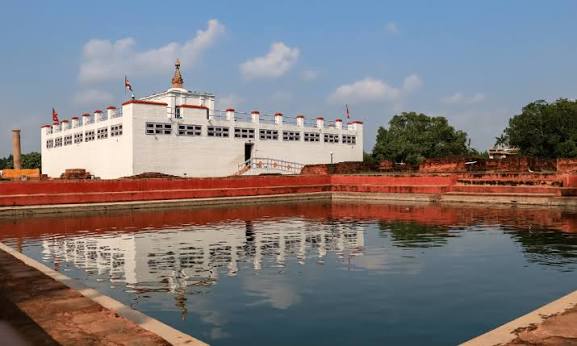
Maya Devi Temple. This white temple marks the exact spot, according to tradition, where the Buddha was born. Inside is a protected archaeological site, with brick foundations and a marker stone. In 2013, archaeologists excavating below the temple found traces of an early timber structure, which researchers have linked to a very early shrine. This suggests that people were already honoring the site centuries before the Mauryan era. Photography is restricted inside, and visitors are asked to be silent.
The Ashoka Pillar. Next to the temple stands a stone pillar left by the Indian emperor Ashoka around 249 BCE, when he visited the site. A Brahmi inscription on it records that Ashoka came here, honored the place where the Buddha was born and reduced the taxes of the village. This pillar is one of the most important pieces of evidence that Lumbini is the real birthplace, since it was carved while memory of the Buddha was still fresh.
Puskarini (Sacred Pond). According to tradition, Queen Maya Devi bathed here before the birth, and the newborn was given his first bath. The pond is calm and lined with steps, reflecting the temple and trees. Sitting beside it in the late afternoon, when the light turns soft, is one of the best things to do in Lumbini.
The Bodhi tree. A large, old tree in the garden is hung with prayer flags and colored threads. Pilgrims sit beneath it to meditate, and monks often chant here at dusk.
The Eternal Peace Flame. A flame burns near the entrance of the monastic zone as a symbol of peace in the world.
The Monastic Zone: A Journey Through Buddhist Asia
Just beyond the Sacred Garden, a long canal separates it from the Monastic Zone, where countries have built temples in their own architectural styles. It is divided into two parts.
The East Monastic Zone houses monasteries of the Theravada tradition. The West Monastic Zone has Mahayana and Vajrayana monasteries. Each has its own look. You will find golden stupas, carved wooden halls, soaring white pagodas and quiet courtyards.
Highlights include:
The Myanmar Golden Temple: a gleaming golden structure in Burmese style. The German Buddhist Temple: a grand, richly decorated hall. The Chinese Temple: a large, red-and-gold temple inspired by traditional Chinese design. The Thai Temple: a white temple with fine detailing, known for its beauty. The Royal Thai, Cambodian, Vietnamese, Korean and Japanese temples, each with a unique style. The Tibetan and Nepali monasteries, with colorful murals and giant prayer wheels.
Visit these slowly. Many monasteries welcome visitors quietly, and some monks are happy to speak with guests. Dress modestly, remove shoes where asked and avoid pointing your feet at statues.
The World Peace Pagoda and Museums
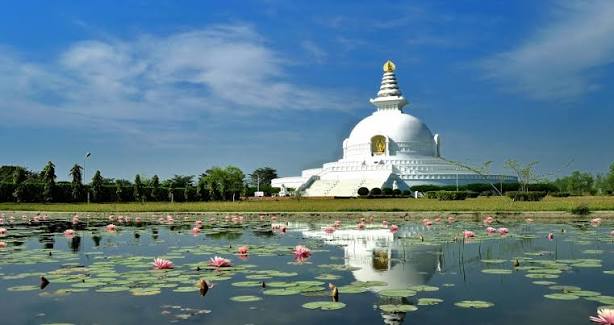
Near the edge of the complex stands the World Peace Pagoda, a gleaming white stupa built by Japanese Buddhists. It makes a great photo at sunrise or sunset.
For history, visit the Lumbini Museum, which displays terracotta figures, coins, manuscripts and artifacts from the region, and the Lumbini International Research Institute, which has a library of Buddhist texts. They are small but worth an hour if you want context.
Ancient Sites Near Lumbini
If you have an extra day, travel a little farther into the countryside to places linked to the Buddha’s early life.
Tilaurakot. Widely believed to be the ancient city of Kapilavastu, where Siddhartha grew up as a prince. The ruins include old city walls, gates and foundations. It is a peaceful place where you can imagine the young prince before he left the palace in search of truth.
Ramagrama. Home to the only undisturbed ancient stupa said to contain a relic of the Buddha. A peaceful, forested site, it is remarkable for its authenticity.
Gotihawa, Kudan and Niglihawa. Ashokan pillars and ancient remains scattered through the countryside, giving the sense of a landscape full of history.
A local guide or taxi driver can arrange a half-day or full-day trip to these sites. Roads can be rough, so allow plenty of time.
How to Get to Lumbini
By air: Lumbini is served by Gautam Buddha International Airport in Bhairahawa, which opened in 2022. Domestic flights run from Kathmandu, and international services have been limited, so check current routes before planning. From the airport, Lumbini is a short drive.
By road: The drive from Kathmandu is roughly 270 to 300 kilometers and can take 8 to 10 hours depending on traffic, road works and weather. From Pokhara, it is roughly 5 to 6 hours. Tourist buses and private cars are common options, and the road passes through scenic hills and plains.
From India: The border at Sunauli is about 20 to 25 kilometers from Lumbini, making it a popular entry for pilgrims from India. Many travelers combine Lumbini with other Buddhist sites in Bodh Gaya, Sarnath and Kushinagar.
Getting Around
The Lumbini complex is large and flat. The sacred garden is walkable, but the monastic zone is spread across several kilometers. Options include bicycles (the most popular choice), rickshaws, electric carts and walking. In the cool season, cycling from monastery to monastery is one of the nicest ways to spend a day.
Best Time to Visit Lumbini
October to March is the best period. The weather is dry and mild, with pleasant days and cool mornings. December and January can bring fog and chilly nights, but the atmosphere is peaceful.
April to June is very hot, with temperatures that can go above 40°C. If you visit then, go early in the morning and again late in the afternoon.
July to September is the monsoon, with heavy rain and humidity. Lumbini turns green and quiet, but travel and sightseeing are less comfortable.
Buddha Purnima, the full moon day in April or May, is the biggest event of the year. Celebrated as the Buddha’s birthday, it fills Lumbini with pilgrims, prayers, processions and offerings. It is unforgettable, but it is also crowded, so book accommodation early. The exact date changes every year with the lunar calendar.
Where to Stay and Eat
Lumbini offers a range of places to stay, from simple guesthouses to comfortable hotels, along with monastery guesthouses that welcome pilgrims. Some monasteries have their own rules about behavior and mealtimes, so ask before booking. Many travelers also stay in nearby Bhairahawa or Siddharthanagar, which offer more variety.
Food is mostly vegetarian-friendly. You will find Nepali dal bhat, Indian dishes, Tibetan momos and thukpa, and in the monastic zone, some Asian specialties. Try the local sweets and tea at small stalls near the entrance.
A Simple Two-Day Plan
Day 1: The sacred center. Arrive at the Sacred Garden in the early morning, when it is cool and quiet. See the Maya Devi Temple, the Ashoka Pillar and the Sacred Pond, then sit under the Bodhi tree. After lunch, visit the museum and research institute. Return at sunset to the pond and the Peace Flame.
Day 2: Monasteries and ancient sites. Rent a bicycle and explore the East and West Monastic Zones. In the afternoon, take a short trip to Tilaurakot or Ramagrama. Finish at the World Peace Pagoda for the evening light.
If you have only one day, focus on the Sacred Garden in the morning and the monasteries in the afternoon.
Practical Tips Dress modestly. Cover shoulders and knees, and remove shoes before entering temples. Stay quiet. The sacred garden is a place of worship. Keep your voice low and avoid loud calls or music. Photography. Allowed in most outdoor areas, but restricted inside the Maya Devi Temple and some monasteries. Ask first. Tickets and hours. Entry to the Sacred Garden and the Maya Devi Temple may involve a fee for foreign visitors, and opening times can change. Check the latest rates and hours before you go. Bring water, sunscreen and a hat. The complex has little shade in places, and the sun can be strong. Bring cash. Smaller shops and rickshaws may not accept cards. Hire a guide for history. A good local guide explains the inscriptions, myths and archaeology in a way no sign can. Birds and Nature
Lumbini is also a quiet place for wildlife. The surrounding farmland is known for Sarus cranes, the world’s tallest flying birds, which are often seen in pairs in the fields near the sacred area. Lumbini’s gardens, ponds and trees also attract many other birds, so bring binoculars if you enjoy bird watching.
What Lumbini Teaches
You do not have to be Buddhist to feel something here. Lumbini carries a simple message that speaks to everyone: that all people suffer, that kindness matters and that peace begins inside. The Buddha taught that we should not follow anything blindly, but test it by experience.
Whether you come as a pilgrim, a history lover or simply someone tired of noise, Lumbini offers a rare gift: a place to slow down. Sit by the pond. Listen to the chanting. Let the afternoon pass.
Final Thoughts
Many places in Nepal take your breath away. Lumbini does the opposite. It helps you breathe.
If you are planning a trip across Nepal, set aside at least a day or two for it. After the mountains of Everest, the lakes of Pokhara and the jungles of Chitwan, Lumbini adds the missing piece: the spiritual heart of the country, and the quiet place where one of the world’s great teachers began his journey.