Wildlife & Conservation
Black Softshell Turtle: The Critically Endangered Turtle Found in Nepal
Himal Shahi Thakuri · Oct 25, 2026 · 8 min read
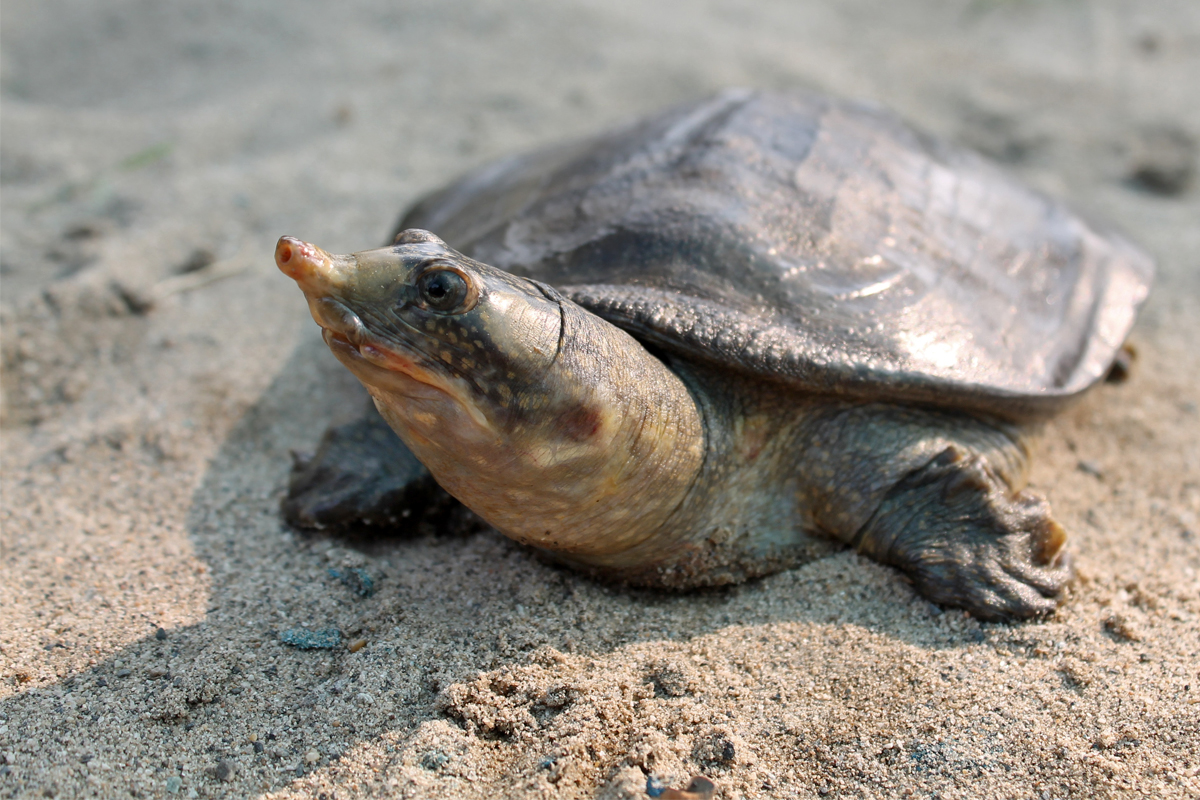
In the quiet wetlands of South Asia, some of the most extraordinary wildlife remains hidden beneath the surface of freshwater habitats. Among these elusive animals is the Black Softshell Turtle, a remarkable reptile whose survival has become an important concern for conservationists.
Known scientifically as Nilssonia nigricans, the Black Softshell Turtle is classified as Critically Endangered on the IUCN Red List of Threatened Species. Once widely misunderstood in scientific records and long thought to survive mainly in protected temple ponds, the species has since been documented in natural river and wetland habitats across parts of South Asia.
Nepal became an important part of this conservation story when researchers documented the species at Betana Wetland in Belbari, Morang, in 2022. The finding, reported publicly in 2023, highlighted the importance of Nepal’s wetlands as habitats for threatened freshwater wildlife.
For anyone interested in Nepal’s biodiversity, the Black Softshell Turtle offers a compelling example of why even familiar-looking wetlands deserve careful protection.
What Is the Black Softshell Turtle?
The Black Softshell Turtle is a freshwater turtle belonging to the family Trionychidae, a group commonly known as softshell turtles. Unlike turtles with hard, heavily patterned shells, softshell turtles have flatter, more flexible shells covered by leathery skin.
Its scientific name, Nilssonia nigricans, distinguishes it as a particular species within the genus Nilssonia. Adults can become remarkably large, with shell lengths approaching 78 centimetres and potentially more in some reported accounts. Large individuals may weigh several tens of kilograms.
Its flattened body helps it move through water, while its specialised shape and behaviour suit life in freshwater environments. Like other softshell turtles, it can spend considerable time submerged, making it difficult to observe in the wild.
Although its common name suggests a uniformly black appearance, colouration can vary with age and individual characteristics. Accurate identification may require expert examination because some related softshell turtle species look similar.
Where Is the Black Softshell Turtle Found?
The species has been documented in parts of Bangladesh, northeastern India, and Nepal. Its known habitats include freshwater rivers, floodplain wetlands, and some managed ponds.
Historically, the Black Softshell Turtle became famous through its association with a pond at the Hazrat Sultan Bayazid Bostami shrine in Chattogram, Bangladesh. For many years, its survival in the wild was uncertain. Further research and field surveys subsequently established that the species also occurs in natural aquatic habitats.
The Black Softshell Turtle in Nepal
One of the most significant records in Nepal comes from Betana Wetland in Morang District, eastern Nepal. Research conducted in 2022 documented the species at this wetland, and the discovery received national media attention in August 2023.
Betana Wetland is an important freshwater habitat, demonstrating how community-managed and natural wetland environments can support wildlife of conservation importance.
However, a record at one wetland does not establish the size or stability of the entire Nepalese population. Continued research is needed to understand its distribution, reproduction, habitat requirements, and long-term survival in the country.
Readers should also note that Betana Wetland is in eastern Nepal, not Chitwan. Although Chitwan has rich turtle diversity, the presence of the Black Softshell Turtle should not be assumed at every wetland or river in the region.
Why Is the Black Softshell Turtle So Rare?
The Black Softshell Turtle is globally classified as Critically Endangered. This category indicates an extremely high risk of extinction in the wild.
According to its IUCN Red List assessment, the species has experienced severe population declines associated with historical and continuing exploitation. Several pressures can threaten freshwater turtles throughout South Asia.
1. Habitat Loss and Wetland Degradation
Freshwater turtles depend on suitable aquatic habitats for feeding, resting, and reproduction. Wetland drainage, river modification, water pollution, and development can reduce the availability and quality of these environments.
Changes to riverbanks and nesting areas can also affect the turtle’s ability to reproduce successfully.
2. Illegal Collection and Exploitation
Turtles are vulnerable to capture for consumption, trade, and other human uses. Because many species grow slowly and take years to reach reproductive maturity, the loss of adult animals can have a serious effect on population recovery.
The Black Softshell Turtle’s conservation status makes protection from capture and illegal trade especially important.
3. Disturbance at Nesting Sites
Successful reproduction depends on suitable nesting areas and the survival of eggs and hatchlings. Disturbance along sandy riverbanks, habitat alteration, and the loss of nesting sites can reduce the number of young turtles that survive.
Protecting adult turtles alone may not be enough if the species cannot reproduce successfully in its remaining habitats.
4. Limited Scientific Information
Although researchers have documented the species across several areas, important questions remain about individual populations, movement patterns, breeding success, and habitat use.
In Nepal, further field surveys and monitoring are particularly valuable for understanding how the species uses wetlands and what measures would best protect it.
What Makes the Black Softshell Turtle Special?
The Black Softshell Turtle is more than a rare reptile. Its survival illustrates the close relationship between freshwater wildlife and healthy wetland ecosystems.
Its flattened, leathery shell distinguishes it from many familiar hard-shelled turtles. Its aquatic lifestyle and ability to remain underwater for extended periods make it well adapted to freshwater environments.
The species also has a notable conservation history. It was once believed to have disappeared from the wild, but subsequent research confirmed surviving populations in natural habitats. This history demonstrates why scientific surveys are important: species thought to be extremely rare or absent from an area may still survive in habitats that have not been adequately studied.
Its continued presence in Nepal is a reminder that the country’s biodiversity extends beyond its famous mountains, forests, rhinos, and tigers. Rivers and wetlands also support wildlife that deserves attention and protection.
Why Wetland Conservation Matters in Nepal
Nepal’s wetlands support fish, amphibians, reptiles, birds, and numerous other forms of life. They also contribute to water storage, local livelihoods, and the ecological health of surrounding landscapes.
Protecting wetlands can benefit many species at once. Practical measures include reducing pollution, protecting natural riverbanks, preventing illegal wildlife collection, and maintaining suitable nesting and basking areas.
Community participation is equally important. Local residents, wetland management groups, researchers, schools, and conservation organisations can help identify wildlife, report threats, and encourage responsible behaviour around sensitive habitats.
In places such as Betana Wetland, conservation efforts should be supported by reliable population monitoring and scientific evidence. Protecting a species requires more than recognising its rarity; it requires understanding the conditions it needs to survive and reproduce.
How Can Visitors Help Protect Rare Turtles?
Visitors exploring Nepal’s wetlands can support conservation through simple, responsible actions:
* Observe turtles from a respectful distance. * Never catch, handle, feed, or remove a wild turtle. * Avoid disturbing riverbanks, nesting areas, and aquatic vegetation. * Do not purchase turtles or products made from protected wildlife. * Follow the instructions of local conservation staff and wetland authorities. * Share accurate information about threatened species and their habitats.
If you encounter a turtle that appears injured or is being illegally collected, contact the appropriate wildlife authorities rather than attempting to capture or transport it yourself.
Wildlife photography can also raise awareness, provided it does not disturb the animal or reveal sensitive locations that could expose it to harm.
Frequently Asked Questions
Is the Black Softshell Turtle endangered?
Yes. The Black Softshell Turtle is classified as Critically Endangered on the IUCN Red List, reflecting its extremely high risk of extinction in the wild.
What is the scientific name of the Black Softshell Turtle?
Its scientific name is Nilssonia nigricans.
Where was the Black Softshell Turtle found in Nepal?
The species was documented at Betana Wetland in Belbari, Morang District, following research conducted in 2022.
Is the Black Softshell Turtle found in Chitwan National Park?
Nepal has several freshwater turtle species, and Chitwan supports important turtle habitats. However, the Betana Wetland record does not establish that the Black Softshell Turtle occurs in Chitwan National Park. Reliable species-specific records are needed before confirming its presence there.
Why is the Black Softshell Turtle threatened?
Major concerns include historical exploitation, habitat degradation, disturbance of nesting areas, and pressures on freshwater ecosystems.
Can people keep a Black Softshell Turtle as a pet?
It is a threatened wild species, not an animal to collect from nature. Wildlife protection and international trade rules may apply. Anyone encountering one should leave it undisturbed and seek guidance from the relevant wildlife authorities.
Conclusion
The Black Softshell Turtle is a powerful reminder that some of Nepal’s most important wildlife discoveries happen far from the country’s famous mountain landscapes. Its documentation at Betana Wetland placed a spotlight on the conservation value of eastern Nepal’s freshwater habitats.
Yet discovering a threatened species is only the beginning. Long-term protection depends on healthy wetlands, responsible communities, continued scientific research, and effective action against illegal collection and habitat destruction.
By protecting the places where freshwater turtles live and reproduce, Nepal can help preserve a remarkable part of South Asia’s natural heritage for future generations.
Sources and further reading
* IUCN Red List: Black Softshell Turtle (Nilssonia nigricans) * The Himalayan Times: Critically endangered Black Softshell Turtle found in Belbari * IUCN/SSC Tortoise and Freshwater Turtle Specialist Group: Turtles in Trouble