Wildlife & Travel
Bengal Tiger in Nepal: Facts, Pugmarks, Life Span, Where to See Them and Best Time to Go
Himal Shahi Thakuri · Oct 25, 2026 · 11 min read
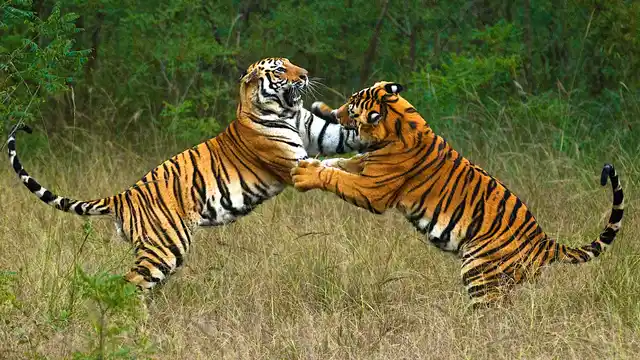
Before you see a tiger in the wild, you usually feel the jungle change. The monkeys stop chattering. The deer freeze, ears pointing in one direction. Even the birds go quiet. Then, if you are lucky, a shape the color of dry grass steps out of the shadows, and you forget to breathe.
That moment is why people travel to Nepal’s Terai. It is even more remarkable because not long ago this animal was vanishing.
The Tiger That Almost Vanished
Poaching and the loss of forest pushed wild tigers to the edge of extinction across Asia. Nepal was no exception. In 2009, a national count found only about 121 tigers in the whole country.
In 2010, Nepal and the other tiger countries promised to double their wild tigers by 2022. Most fell short. Nepal succeeded, and then some. The 2022 national survey counted 355 tigers, nearly triple the 2009 number. It came from stronger anti-poaching patrols, protected forests, restored corridors and local communities who chose to live alongside big cats. It is one of the great conservation stories of our time.
Meet the Bengal Tiger
The tiger of Nepal is the Bengal tiger (Panthera tigris tigris), also called the Royal Bengal tiger. It is the most numerous tiger subspecies on earth, and it lives in the grasslands, riverine forests and sal woods of the Terai, the green lowland belt along Nepal’s southern border.
It is also one of the largest cats alive. A male Bengal tiger can weigh 180 to 260 kilograms and measure around 2.7 to 3.1 meters from nose to tail tip. Females are smaller, usually 100 to 160 kilograms. Their canine teeth reach up to about 7 to 10 centimeters, and their roar can carry for around two to three kilometers on a still night.
No Two Tigers Have the Same Stripes
A tiger’s stripes are like human fingerprints: each one is unique. The pattern is on the skin as well as the fur, so even a shaved tiger would still be striped. Scientists and rangers in Nepal use this to identify individual tigers from camera trap photos, and that is how national tiger counts are done today.
The stripes are also superb camouflage. Deer cannot see the color orange well, so in dappled light and tall grass the tiger simply melts away. Look at the back of a tiger’s ears and you will see white spots. Some researchers think these look like eyes from behind, which may warn off animals that try to sneak up on a feeding tiger.
Reading the Jungle: Pugmarks
Long before cameras, rangers and trackers knew tigers by their footprints, known as pugmarks. Even today, a fresh pugmark in river mud is one of the most thrilling sights on a jungle walk.
Here is what the pros look for.
A tiger’s pugmark is large and round, with four toes and a big, three-lobed pad at the back. The claw marks do not show, because tigers keep their claws retracted when they walk, like a house cat. If you see claw marks, you are probably looking at a dog or a hyena.
Size tells a story. A male’s pugmark is wider, squarer and usually around 13 to 16 centimeters across, while a female’s is smaller and more oval. A young cub’s print is no bigger than a large coin. Trackers also look at the depth, edge and dryness of the print to judge how fresh it is, and whether the tiger was walking, stalking or running.
Fresh pugmarks pressed into wet sand along a river are a sign that a tiger passed in the last few hours. Guides in Chitwan and Bardiya can read them so well that they will tell you which way the animal was heading, and sometimes even whether it was alone.
The Smell of the Tiger
A tiger’s world is built from smell as much as sight. Tigers are solitary animals, and they leave messages in the forest for other tigers, long after they have moved on.
A male tiger sprays urine on trees, bushes and rocks to mark his territory. This spray holds chemical signals that tell other tigers who passed by, whether it was male or female, and how recently. Tigers also scrape the ground with their back paws, rake tree trunks with their claws and rub their cheeks and flanks on bushes to leave scent from glands on their face and paws.
Here is a strange fact: tiger urine often smells like hot buttered popcorn. The reason is a chemical called 2-acetyl-1-pyrroline, which is also found in popcorn and basmati rice. If you ever catch that sweet, buttery smell in the middle of a jungle, a guide will tell you to stay alert.
When a tiger sniffs a scent mark, you may see it lift its head, curl back its lips and open its mouth slightly in a grimace. This is called the flehmen response, and it helps move the scent to a special organ on the roof of the mouth to read the message in detail.
How Long Does a Tiger Live? Life Span and Growing Up
In the wild, a Bengal tiger usually lives for about 10 to 15 years. In protected zoos and breeding centers, with no hunting, injury or rivals, tigers can live to 20 years or more. Wild life is much harder. Fights with rival tigers, injuries while hunting, old age and conflict with humans are some reasons why wild tigers rarely reach old age.
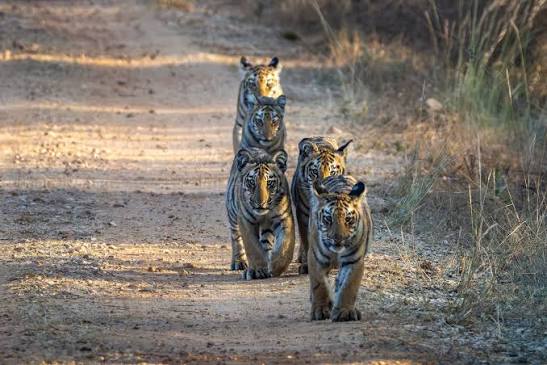
A tigress is usually ready to breed at around three to four years old. After mating, she carries her cubs for about 100 to 110 days, around three and a half months. She gives birth in a hidden den, in thick grass, a cave or a hollow, to usually two to four cubs. The cubs are born blind, weigh around one kilogram, and depend on their mother’s milk.
Their eyes open after about a week, and they start eating meat at around two months. Then comes the hard part. Mothers raise cubs alone, and many cubs do not survive their first year. The survivors stay with their mother for about two years, learning to stalk, ambush and read the jungle. Then they leave to look for territory of their own. Young males usually travel farther than young females, who often settle near their mother.
Territory: A Tiger Needs Space
Tigers are not pack animals. Each adult needs its own territory. A male in the Terai may range over about 60 to 100 square kilometers or more, depending on how much prey there is. A female holds a smaller area, often around 20 square kilometers. A male’s range often overlaps with several females, which he guards from other males.
This is why conservation matters so much. Tigers need big, connected forests. In Nepal, protected corridors link Chitwan, Parsa, Bardiya, Banke and Shuklaphanta with forests across the border in India, so that young tigers can find new homes without being trapped in small pockets.
How a Tiger Hunts
The tiger is a stealth hunter, not a long-distance runner. It creeps up as close as possible, using grass and shadow, then explodes into a short charge. It can reach about 50 to 65 kilometers an hour for a few seconds, and leap several meters. But most hunts fail: a tiger may succeed only about one time in ten or more attempts.
Its senses are tuned for the night. A tiger’s night vision is around six times better than a human’s, thanks to a reflective layer behind its eyes that makes them glow. Whiskers pick up tiny changes in air and movement. A tiger usually kills by a bite to the throat or the back of the neck.
In Nepal, tigers feed mostly on chital (spotted deer), sambar deer, wild boar, barking deer and sometimes gaur, a huge wild ox. A tiger can eat up to 30 kilograms of meat in one meal, and may then rest for days, dragging the kill into cover and returning to feed on it.
Unlike most cats, tigers love water. They swim well, cool off in rivers on hot days and sometimes even hunt in water. In Bardiya and Chitwan, you may see a tiger crossing a river or lying half-submerged in a pool.
Why Tigers Matter
Tigers sit at the top of the food chain. When there are tigers, it means there are enough deer and boar, which means the grasslands and forests are healthy. Protecting the tiger protects the one-horned rhino, the river, hundreds of bird species and the clean water that villages downstream depend on. Scientists call the tiger an umbrella species for exactly this reason.
Where to See Tigers in Nepal
Chitwan National Park is the best known. It is a UNESCO World Heritage Site, easy to reach from Kathmandu or Pokhara, and offers jeep safaris, canoe rides and guided walks. It also shelters the greater one-horned rhinoceros, so even a day without a tiger is rarely wasted. It is a good choice for first-timers.
Bardiya National Park, in the far west, is quieter and wilder. It has one of the highest tiger populations in the country, fewer visitors and a remote feel. Many wildlife lovers feel Bardiya gives the best chance of a peaceful, uncrowded sighting. The Karnali River runs through it, so you may also see wild elephants, gharials and Gangetic dolphins.
Other tiger areas include Parsa, Banke and Shuklaphanta National Parks, which are less visited but vital parts of Nepal’s tiger landscape.
Can You Really See a Tiger?
Honestly, maybe. Tigers are shy, hunt mostly at dusk and night, and are experts at vanishing into tall grass. Many visitors leave without a sighting. But your odds improve a lot if you stay several days, go out at dawn and dusk, and follow a skilled guide. Sightings have been rising along with the tiger population.
Even without a tiger, the signs are thrilling: fresh pugmarks in the mud, a claw-scraped tree, a sudden alarm call from a deer, that faint popcorn smell on the air. You come to feel the tiger long before you see it.
Best Time to See Tigers in Nepal
February to April is widely considered the best time. It is warm and dry, the grass is thinner, and animals visit rivers and waterholes to drink. In Chitwan, villagers are allowed to cut thatch grass for a short period each winter, which opens up views across the grasslands.
October to January is also good. Skies are clear, mornings are cool and wildlife is active, though January mornings can be foggy and cold.
May to June is very hot, often above 40°C. The heat drives animals to water, which can improve sightings, but it is tough on people.
July to September, the monsoon, is the hardest time. Heavy rain, tall grass and flooded rivers hide wildlife and limit activities.
The simple rule: go between February and April, and always choose the early morning and late afternoon safaris.
What a Tiger Safari Feels Like
You will explore by open jeep, boat or canoe, or on foot with a trained guide. The jeep covers the most ground. The canoe is silent, so you can drift past crocodiles, kingfishers and rhinos. A walking safari is the most thrilling, because you notice every sound, but it should only be done with a licensed guide, since dangerous animals live in these forests.
Nepal’s guides are remarkable. Many grew up on the edge of the park and can read a broken twig, a warning call or a paw print the way you read a road sign. Ask them questions. They love to share.
Living Beside Tigers
Many communities near the parks, including the Tharu people, have lived beside tigers for generations. Their culture respects the forest deeply, and many families now run homestays and work as guides and naturalists.
It is not always easy. Tigers and leopards sometimes kill livestock and, rarely, people, and these losses hurt families. Nepal shares part of park income with nearby villages and has compensation programs. Staying in a locally owned lodge, hiring local guides and buying local crafts are simple ways to help that balance work.
Tips Before You Go Stay at least three nights. One safari is a gamble. Several give you a real chance. Hire a good guide or naturalist. They turn a drive into an adventure. Wear dull colors such as green, brown and khaki, and avoid strong perfume. Stay quiet and keep your distance. Never leave the vehicle or group, and never chase an animal. Bring binoculars and a zoom lens, and turn off your flash. Check permits and fees. Park entry requires a permit, and costs change. Confirm with your lodge or the park office. A Last Word
Nepal showed the world that a tiger can come back from the brink. It took rangers, villagers, scientists and a great deal of patience. Every pugmark in the mud and every glimpse of orange in the grass is proof that it worked.
If you ever stand in the dawn mist of the Terai, listening to the forest wake up, you will understand why this animal is worth protecting. You may or may not see a tiger. But you will feel that it is out there, watching.